
Artificial General Intelligence is the Top ... of a House of Cards of Trivialized Concepts.
$600 billion are invested to construct the two top levels of a flimsy house of cards
I spent a decade studying how AI researchers compare their systems to human intelligence. They’re not just simplifying. They’re building claims of human like intelligence, of “artificial general intelligence” analogies they’ve forgotten are nothing but analogies. Forgetting that maps that are not the territory, that words are not the thing they describe. The tech industry has poured over $600 billion into scaling up these AI systems1. Governments are rewriting policy. Companies are restructuring entire business models. All based on a house of cards.
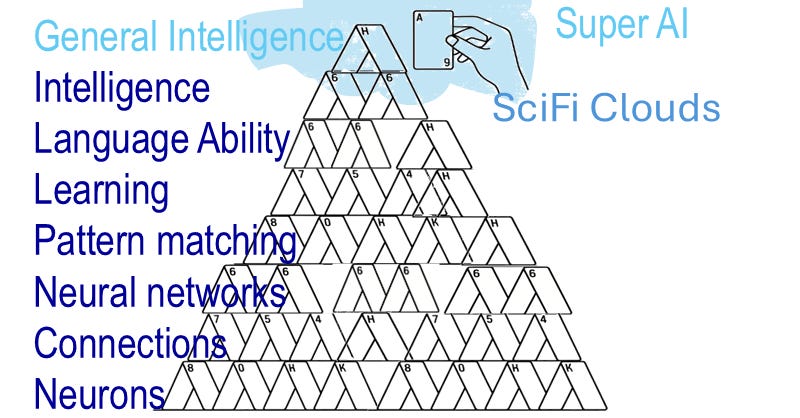
The house of cards starts with something simple. Then it reaches for the sky. Each level rests on the one below it. But worse, each level dumbs-down more fascinating and important complexity. And at the foundation? A mathematical formula that is considered to be like a biological neuron.
Level 1: The Foundation That Isn’t
A biological neuron is staggering in its complexity and wide range of abilities. If you want to compare it to a computer, keeping in mind that this is a crude simplification, every single little neuron is not like transistor, but is all by itself like a little network of analog processors and memory, of hardware and software at the same time.
Your brain is built from a massive collection of these specialized cells: 86 to 100 billion neurons. Each neuron is an electrochemical processor designed for complexity, utilizing analog data processing and forming up to 300.000 thousands of connections with its neighbors. This dense connectivity allows for the brain’s most remarkable feature: structural plasticity, the ability to physically rewire itself based on experience and learning.
Signals are sent chemically via neurotransmitters and receptors and electrically through structures like ion channels. Within the cell, complex calculations occur (dendritic computation) before the signal is rapidly transmitted (axonal signal propagation). This non-stop activity, fully supported by the cell’s own energy management (metabolic integration), makes the neuron the fundamental, adaptive unit of thought and consciousness.
What did AI researchers do with this marvel of biological engineering? They turned it into this: y = f(w₁x₁ + w₂x₂ + ⋯ + wₙxₙ + b)
A weighted sum. An activation function. The mathematics became more complex but that’s it. They called it a node. But then as they had been doing since the fifties and as they keep doing until today, they chose to compare its function with a neuron, because it does one of the task neurons also do, and they called it a neuron.
In my forthcoming book, I need an entire chapter to summarize all the ways a single biological neuron processes information. I need one paragraph to explain this formula.
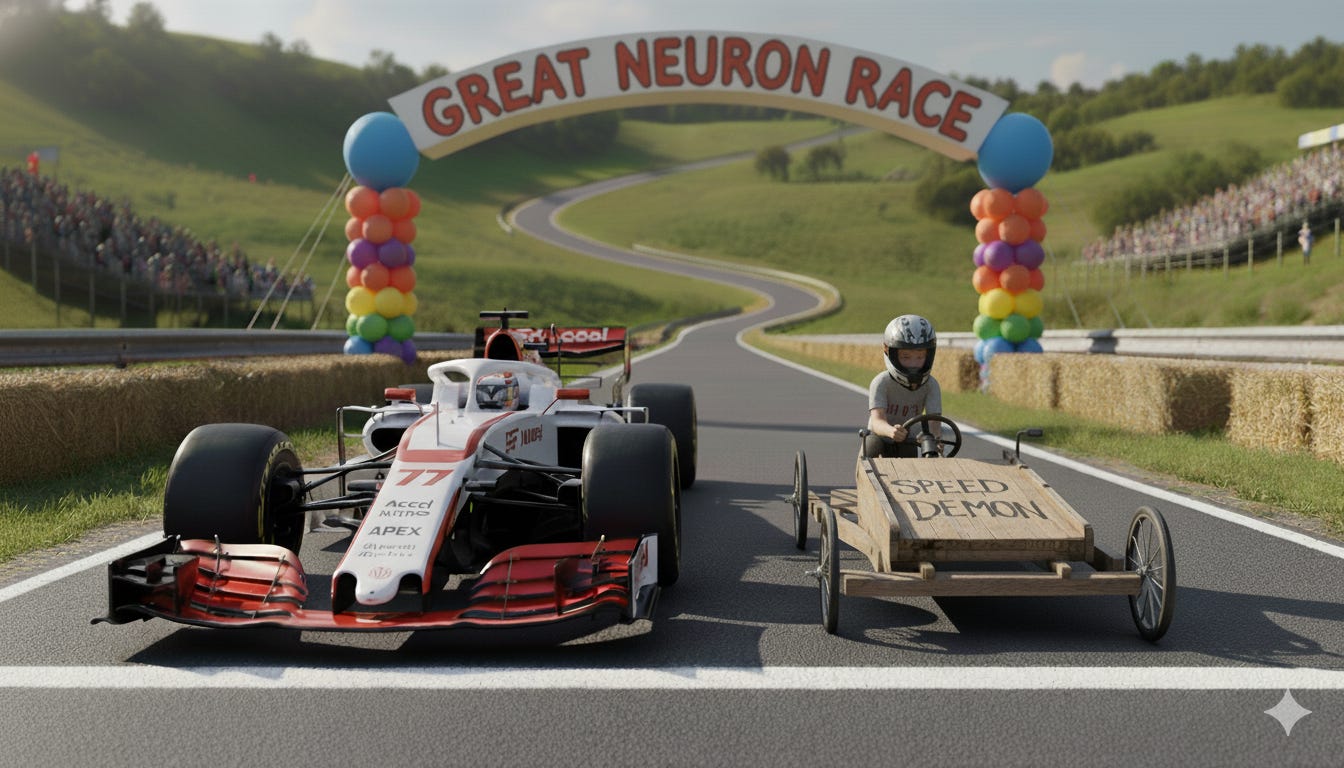
The metaphor seems a harmless simplification at first. The node functions “as if” it were a neuron. It’s like a boy whose soapbox functions “as if” it were an F1 racing car. The “as if” in his imagination. But then the “as if” disappears, and AI professionals start saying, “a node is like a neuron” and “a node functions like a neuron.” They even replace the neutral word ‘node’ with ‘neuron’. The trivialization becomes invisible. And even worse, some begin thinking the biological neuron basically does the same think as a digital one. It’s similar to a boy who dreams his soapbox is an F1. This can be a happy, funny illusion, until he starts thinking it really is an F1. That’s when it becomes a delusion.
This is where the house of cards begins.
Level 2: The Connections
Synaptic connections between neurons involve dozens of neurotransmitter types. Receptor subtypes. Modulation mechanisms. Activity-dependent plasticity. Bidirectional signaling. Long-term potentiation. Synaptic pruning. Neurotransmitter release dynamics. Receptor trafficking. Retrograde signaling etc etc.
The AI version?
sᵢⱼ = wᵢⱼ · xᵢ
A weight multiplied by an input. That’s the entirety of the “connection.”
I remember the moment this hit me. I was reviewing a paper that casually referred to “synaptic plasticity” in a neural network. The authors meant: we adjusted the weights. But synaptic plasticity in biology is an intricate synergy of molecular machinery, time-dependent changes, and structural reorganization. Real neurons can even bypass direct synaptic connections through volume transmission, a kind of “wireless” signaling in the brain.
None of this appears in artificial neural networks. None of it. But we call them “synaptic connections” anyway. Second level of cards on the stack.
Level 3: The Network
Now we’re building networks of these formulas.
The biological version: 150 billion processing cells (neurons plus glial cells that we now know participate in information processing). Analog signaling with innumerable possible states. No distinction between hardware and software. Integrated memory and processing. Continuous reorganization from birth to death. Embodied in a living organism that on it’s turn is embodied in the real world.
The AI version: Digital matrices of mathematical formulas.
Ignored in the jump: Representational drift. Neuroplasticity. Glial cell participation. Volumetric signaling. Metabolic constraints. Developmental stages. The integration of everything with everything else.
But we call them “neural networks.” anyway, Third level of cards.
Level 4: The Processing
Human information processing integrates perception, emotion, memory, motor control, and social cognition and much more. It’s embodied in a physical world. Shaped by millions of years of evolution. Grounded in meaning derived from interaction with reality.
AI processing? Statistical pattern matching in training data.
This is not a small difference. This is a difference of kind.
I tested this repeatedly. I’d ask AI systems simple questions that required understanding context or meaning in the real world. The failures were consistent and revealing. Not because the systems needed more data or more parameters. But because they’re doing something fundamentally different from understanding.
Brush aside: Embodied cognition. Sensorimotor integration. Emotional valence. Contextual understanding. Causal reasoning. World models. The entire scaffolding of meaning.
But we call it “artificial intelligence.” Fourth card.
Level 5: The Learning
Human learning is continuous and lifelong. You learn through embodied interaction with the world. Single experiences can change your behavior. You integrate new knowledge with existing understanding. You transfer learning across domains. Learning never stops, even as you read this sentence, the connections in your brain are changing, you’re learning.
The process involves multiple memory systems: episodic, semantic, procedural, working memory. Each integrated with emotion, attention, motivation. Learning happens during sleep. Learning happens through social interaction. Learning shapes your developing model of the world.
“Deep learning”?
Billions of data analyzed and patterns translated into numbers. These numbers are then crunched in huge networks of billions of nodes and the basic learning ends. Parameters freeze. The model is deployed.
Yes, during training there’s feedback, errors propagate backward through the network, adjusting weights. This happens millions of times across enormous datasets. The system processes examples, calculates errors, updates parameters. That’s the “learning.”
Then training stops. The model is deployed. It processes new inputs using those fixed weights, but it doesn’t learn from them. No continuous learning. No integration. No generalization outside the training data. No growth. No development.
When I first encountered “machine learning”, I thought it meant systems that learn continuously like humans. The reality was sobering. The “learning” happens once, with a fixed dataset. After that? Pattern matching with frozen parameters.
Some systems retrieve from databases, that’s lookup, not learning. Some can be fine-tuned, that’s a separate, expensive process, not continuous learning from experience.
Turned a deaf ear to: Continuous learning. Single-shot learning. Transfer across contexts. Integration with existing knowledge. Embodied learning through interaction. The entire dynamic, adaptive nature of biological learning.
But we call it “machine learning.” : a fifth level of cards.
Level 6: The Language Ability
This is the level that convinced most people the tower was solid and made them dreaming about human like intelligence.
Human language capacity is grounded in embodied experience. It integrates with genuine understanding of meaning. It connects to goals and intentions. It’s shaped by social interaction. Learned through immersion in a meaningful world.
LLM text generation? Statistical prediction of next tokens based on patterns in training data.
When ChatGPT writes a sentence, it’s not expressing an idea. It’s calculating which word is most likely to follow based on billions of previous examples. No understanding. No meaning. No connection to reality.
The outputs can look remarkably human-like. But the process underneath? It’s the same mathematical formulas from Level 3, just scaled up. The gap between appearance and reality is stunning.
But the outputs look like human language. So we forget the gap and create a sixth brittle level of cards.
Level 7: The Intelligence
Human intelligence, even in specific domains, is flexible and integrated.
A chess master doesn’t just calculate moves. She understands strategy, adapts to opponents, learns from games, integrates intuition with calculation. A radiologist doesn’t just pattern-match images. He understands anatomy, considers patient history, reasons about possibilities, knows when something doesn’t make sense.
Even when you focus on a specific task, your intelligence brings embodied understanding, contextual awareness, common sense, the ability to know when rules should be broken. Integration with broader knowledge.
AI “intelligence”?
Optimized performance on narrowly defined tasks through pattern matching in training data.
A generative AI that plays chess has no understanding of strategy or rules, just statistical patterns from millions of games. That’s why these multibillion dollar systems cannot play chess2. A generative AI that reads X-rays has no understanding of anatomy, just correlations between image patterns and diagnostic labels. That’s one of the reasons why they make gross errors and why they always need close human supervision. Remove these systems from their narrow domain and they fail completely.
I tested this repeatedly. Ask an AI system something slightly outside its training domain, something that would require common sense or basic reasoning about the real world, and watch it confidently generate nonsense. No ability to recognize when something is absurd. No integration with broader understanding.
Disregarded: Understanding versus optimization. Flexible reasoning versus fixed pattern matching. Common sense. The ability to know when something is wrong even if it matches the pattern. Integration with broader knowledge. Context sensitivity. Embodied meaning.
But we call it “artificial intelligence.” and create a seventh level of cards.
Level 8: The General Intelligence
At the top of our tower, in the cloud of Science Fiction, sits the grandest claim of all: Artificial General Intelligence sometimes called Polymathic AI (see substack).
Human general intelligence: Broad, flexible, generalizing abilities deeply integrated across cognitive, emotional, social, and physical domains. Leonardo da Vinci was a polymath, painter, anatomist, engineer, inventor. Each domain deeply understood through direct interaction with reality. Integrated into a coherent worldview allowing for generalization in many directions. Grounded in embodied experience. Connected across domains through genuine understanding.
You possess this kind of general intelligence. You can read about architecture, then cook a meal, then comfort a friend, then solve a math problem. Each activity drawing on and informing the others. Your knowledge isn’t siloed. Your understanding transfers. You adapt to completely novel situations by integrating what you know in new ways.
This evolved over millions of years. Develops over a lifetime. Enables genuine creativity and insight.
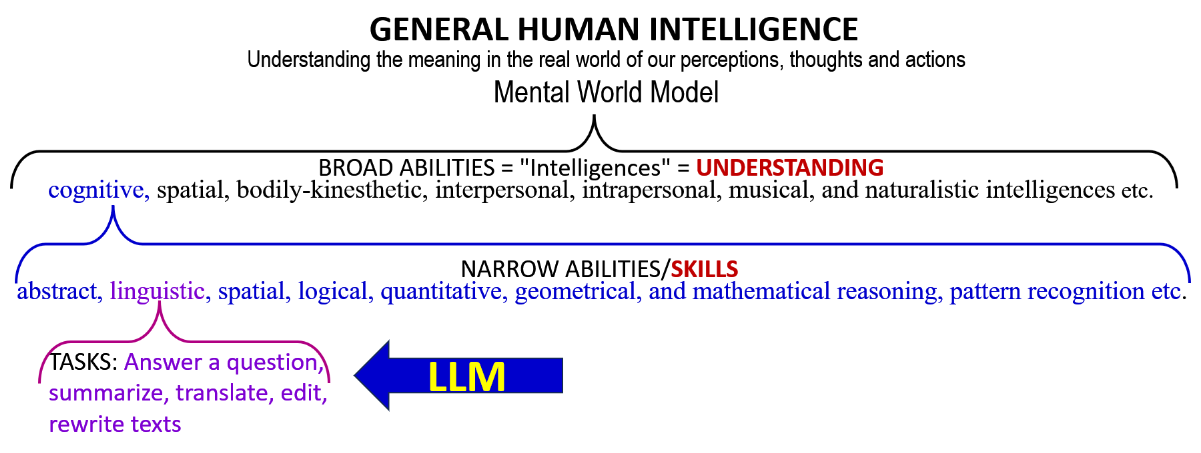
“Artificial General Intelligence”?
The claim that scaling up the same narrow pattern-matching systems, making the formulas bigger, adding more parameters, throwing more data at the problem, will somehow produce human-like general intelligence.
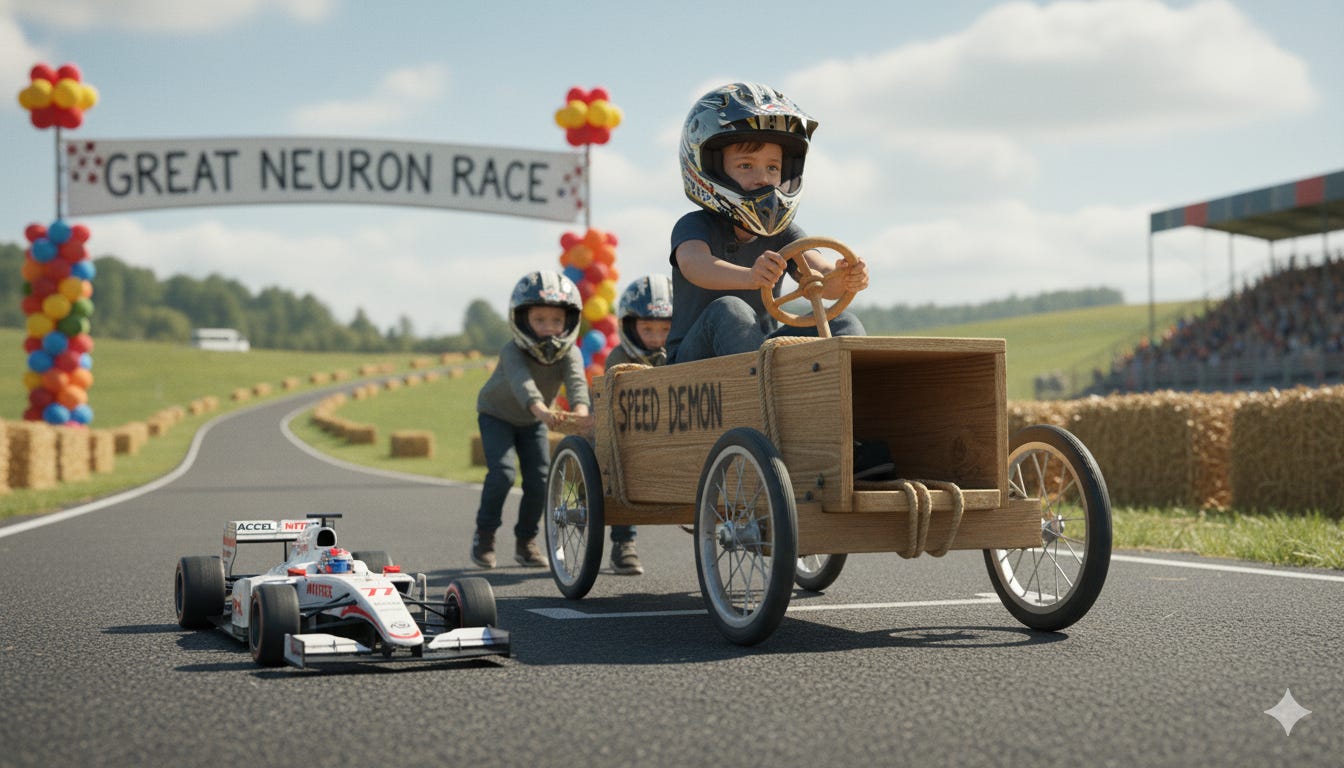
It’s a delusion to think that scaling up the soapbox is going to magically turn it into an F1 racing car.
When I first read the term “Polymathic AI”, I assumed they were being metaphorical. They weren’t.
They believe processing text from multiple domains is equivalent to Da Vinci’s integrated, embodied understanding. They believe that if you just make the networks large enough, feed them enough data, you’ll cross the gap from narrow pattern matching to flexible general intelligence. From correlation to comprehension. From statistical prediction to genuine understanding.
I’ve identified over 40 fundamental gaps between AI and human intelligence. Not differences of degree, differences of kind. But in boardrooms and research labs, people talk about AGI as if it’s just a matter of scale. A few more trillion parameters. A few more years. A few hundred billion more dollars.
Everything given the cold shoulder: The entire edifice of human cognition, consciousness, understanding, meaning-making, and adaptive intelligence. The difference between narrow optimization and flexible general intelligence. Between processing information from multiple domains and integrating knowledge across domains. Between appearing intelligent and being intelligent etc etc etc.
But we call it “Artificial General Intelligence.” Some people say we’ll have it in a foreseeable future, that it is a question of when, not if. But they forget to say when is when: a few years from now, a decade, a century …
The house of cards stands complete. Some AI professionals are already adding another card: “Artificial Super Intelligence” a kind of AGI that overclasses AGI in all domains.
The Critical Error at Every Level
Here’s what makes this a real problem, not just a challenge. At each step, AI-professionals don’t just simplify the meaning of the words they borrow from human sciences, they forget they oversimplify and trivialize. Because they have no knowledge about the biological side of their equation, they treat their simplified analogy as equivalent to the original, even in both directions.
Not just: “The node works like a biological neuron” But also: “The biological counterpart works like our mathematical one”.
This dual error makes the house of cards particularly treacherous. It leads AI professionals to believe things like
-Understanding their simple formulas means they understand biological intelligence.
-Making their formulas more complex will necessarily approach biological intelligence.
-Scaling up these systems is the path to human-level AI
None of this follows.
The gap between Level 1 (mathematical formula = neuron) and Level 8 (AGI) isn’t a gap you can cross by adding more cards to the house. It’s a gap of fundamental kind, not of scale.
Why the House Falls
Each level of the house rests on an analogy that was already a dramatic oversimplification of the level below it.
And at the top? Claims about achieving or surpassing human intelligence, built entirely on mathematical formulas that bear virtually no resemblance to how biological intelligence actually works. This resemblance is not necessary. Seeing birds fly made people dream about flying and in the end they did with techniques different from the birds. But, we never called airplanes “artificial birds” and claimed they had achieved avian general flying. We never borrowed the term “flapping” to describe jet propulsion, then forgot we were speaking metaphorically. We never built a tower of increasingly abstract claims where “wing” became “airfoil” became “lift surface” became “flying” became “superintelligent flight.”
The brothers Wright and all the successive inventors knew exactly what they were building and what they weren’t. They understood the difference between our solution and nature’s solution. The house of cards I’ve described here exists precisely because AI researchers borrowed the language of biological intelligence, then forgot they were borrowing it, then started believing their simplified models were equivalent to, or even explained, the original.
The tech industry is betting hundreds of billions on this tower of cards. Governments are reshaping policy around it. Researchers and especially AI companies are claiming we’re only years away from machines that will match or exceed human intelligence across all domains.
I’ve spent a decade studying these comparisons. The more I learned about both biological and artificial systems, the clearer it became: we’re not on a path to AGI. We’re scaling up a metaphor that was never meant to be taken literally.
The house doesn’t fall because it’s poorly constructed. It falls because there was never solid ground beneath it in the first place.
For deeper exploration of the semantic confusion in AI terminology, see my earlier piece on how AI borrowed our language and created a parallel universe where words mean whatever researchers want them to mean.
What’s the most dangerous metaphor in this tower? Which level do you think does the most damage to clear thinking about AI capabilities? Share your thoughts in the comments.
In this Substack, when I use the term AI I refer to Generative AI like the Large Language Models (LLMs) on which AI-Chatbots are based and that led to a tsunami of unfounded ideas and claims about AI. (more about the other kinds of AI in substack)
The Deep Blue computer system that beat the chess master Garry Kasparov in 1997 was a brute-force calculation machine that made decisions by evaluating a vast number of potential chess moves, rather than relying on the kind of symbolic AI and machine learning techniques used in modern AI
fine thoughts, with - i think - one mistake.
Sensors of the external world can be added to the computing machines, so in principle the learning on 3D data can go on (and it can be made continuous - the question what "continuous" means - like sleep in humans, see "next release after restart").
Couldn't agree more. Could you elaborate on how that initial mathematical formula for a 'neuron' first gained such traction, given the biological complexity you so clearly describe?